
Pillar 3
Private pension provisionPillar 3 of the Swiss three-pillar social system is a voluntary and flexible addition to mandatory pension provision through Pillars 1 and 2.
The aim of Pillar 3 is to close any pension gaps that are not covered by OASI/DI and OPA pensions. It should also enable individual wishes to be fulfilled after retirement. Private pension planning as part of Pillar 3 is growing in popularity. Demographic and social trends in Switzerland have made such planning absolutely necessary if people intend to continue their accustomed lifestyle in old age.

How is Pillar 3 structured?
Pillar 3 is divided into tied pensions (Pillar 3a) and flexible pensions (Pillar 3b). Payments into a Pillar 3a pension can be deducted from your taxable income, whereas a Pillar 3b flexible pension is only tax-privileged subject to certain conditions.
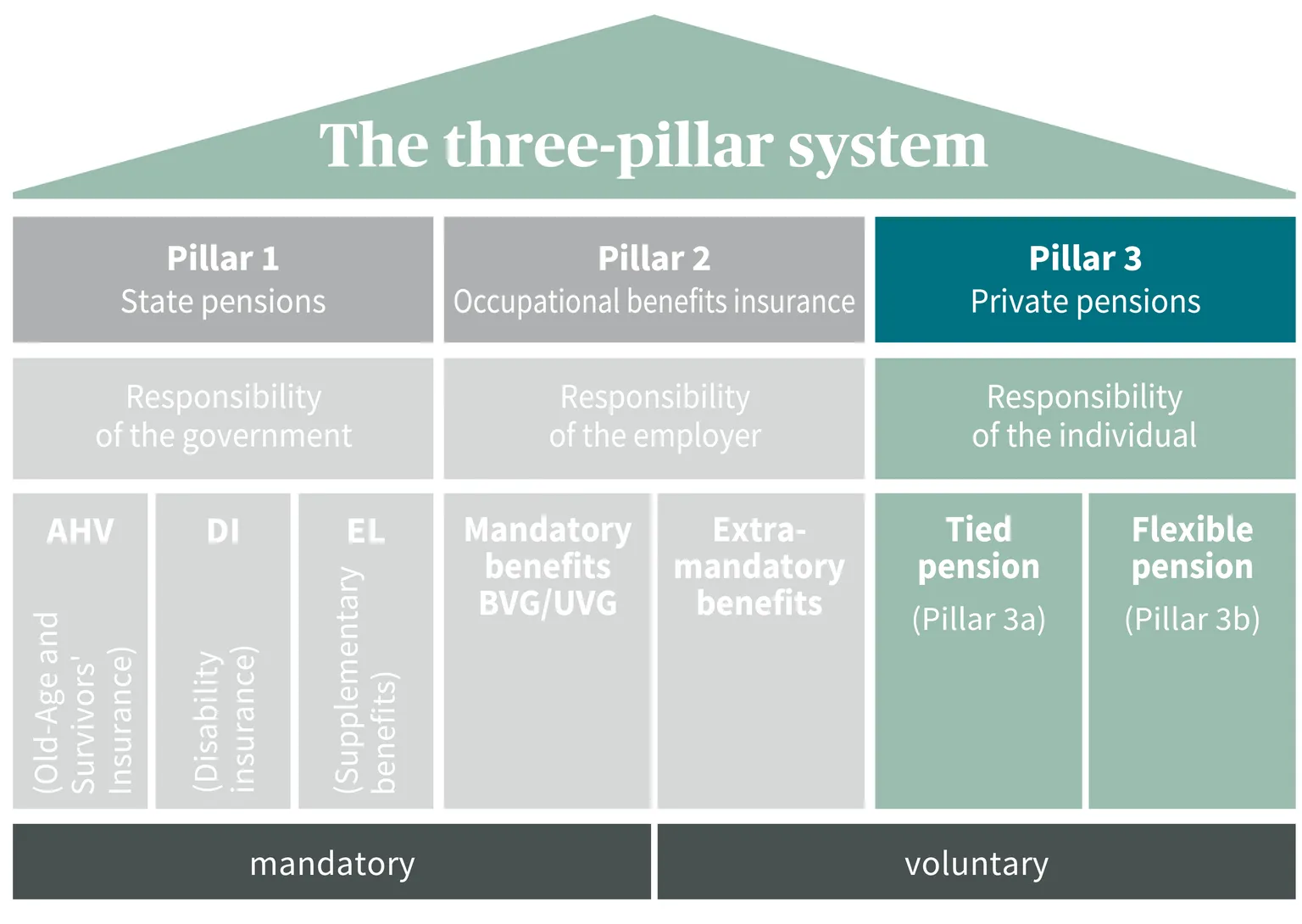
Pillar 3
What is tied pension provision (Pillar 3a)?
Pillar 3a is the tied private pension provision within the Swiss three-pillar system. It systematically supplements OASI and pension funds with a tax-privileged module. If you are gainfully employed and affiliated to a pension fund, you can pay in a maximum of CHF 7,258 in 2026 and deduct this amount in full from your taxable income.
Find out more here: Maximum amount of Pillar 3a
As a general rule, the accrued capital remains tied up to five years before reaching the OASI reference age – except when withdrawing money to purchase residential property, when taking up self-employment or when permanently leaving Switzerland. Those who remain gainfully employed beyond ordinary retirement age can even pay in up to five years longer.
How can I save on taxes with Pillar 3a?
Pillar 3a is one of the most effective tools for legal tax savings in Switzerland. Contributions can be fully deducted from taxable income up to the statutory maximum (further information on the threshold amounts of all three pillars). In addition: For the entire term, interest and earnings remain exempt from income and wealth tax, and your accrued pension capital is not subject to wealth tax either.
When it is paid out, the credit balance will not be counted as other income, but will be taxed separately and at a reduced special rate.
Our tip: Several Pillar 3a accounts further reduce your tax burden upon withdrawal: If you divide your assets among several accounts and withdraw them in different years, you smooth out the tax progression and pay less overall than with a one-time total payout.
Find out more about how you and your family can save on taxes with Pillar 3a.
Who can take out Pillar 3a?
As a general rule, anyone earning an income subject to OASI contributions in Switzerland can pay into Pillar 3a. This is true of far more groups of people than many assume:
- Employees who have joined a pension fund (Pillar 2)
- Self-employed who do not have OPA insurance
- Persons receiving daily benefits subject to OASI from disability insurance (DI)
- Persons receiving daily benefits from unemployment insurance
- Partially disabled persons with earned income subject to OASI contributions
- Employed persons working past the regular retirement age (up to five years)
- Persons who continue to pay contributions despite a temporary interruption in employment, such as in the event of illness, military/civilian service or unemployment
When can Pillar 3a be paid out?
As a general rule, the capital paid into a tied pension (Pillar 3a) can be paid out at the earliest five years before you reach the OASI reference age (formerly: normal retirement age) of 65 for both men and women. The reference age will be gradually raised by three months each year for women in the transitional age group (born between 1961 and 1963) until the new reference age is reached.
Find out more about the payout from a Pillar 3a account here.
How high should the equity component of Pillar 3a be?
How high the equity allocation should be depends above all on the investment horizon and personal risk capacity. As a rule of thumb: The longer the time until retirement, the higher the equity component can be. With a time horizon of more than 15 years up to retirement, a high equity allocation is justifiable because short-term market fluctuations generally balance out over such a long period of time.
If the horizon becomes shorter, the equity allocation should be gradually reduced in order to avoid losses in value shortly before withdrawal. The following general rule applies: Securities solutions with a higher equity component achieve a significantly higher return on average over the long term than pure pension accounts – with correspondingly greater short-term fluctuations.
Which equity allocation makes sense for you depends on your individual situation. Here you can find out how you can save with equities in Pillar 3a.
Bank or insurance company: Where should I take out Pillar 3a?
Whether a third pillar with a bank or an insurance company is more suitable primarily depends on your personal needs. A banking solution offers maximum flexibility for deposits, but does not include any risk coverage. An insurance solution combines saving for retirement with protection against death or disability, but ties you to fixed premiums over the entire contract term.
A detailed comparison of the two options can be found here: Pillar 3a – insurer or bank?
What is flexible pension provision (Pillar 3b)?
Pillar 3b flexible pensions (also known as non-tied pensions) are a form of private pension solution that is a good way to close a pension gap, since the annuity paid by an occupational pension is often not enough to maintain the lifestyle you are accustomed to after retirement. They are not subject to government requirements regarding how much you can pay in, availability or when they are paid out. However, many people do not know that tax savings are also possible with a 3b pension solution, subject to certain conditions.
Pillar 3b flexible pension products often form an integral component of overall solutions such as life insurance policies, investment funds, cash accounts, securities portfolios, residential property or collections of valuable items.
How can I save on taxes with Pillar 3b?
Flexible pension provision also offers attractive possibilities for saving on taxes. For example, tax exemption applies to periodically financed endowment life policies and single premiums, if certain conditions are met. Unlike retirement pensions disbursed from Pillar 3a capital, which are 100% taxable, pension payments from Pillar 3b flexible pension provision are only 40% taxable.
Who can take out Pillar 3b?
In principle, Pillar 3b is open to everyone: Unlike with the tied Pillar 3a, there are no special requirements. You don’t need to have an income from employment or be subject to OASI – as a flexible pension provision, Pillar 3b can be used by anyone living in Switzerland. This makes it suitable, for example, for people who are not gainfully employed, who work part-time or who have already exhausted the maximum Pillar 3a amount.
When can Pillar 3b be paid out?
Unlike Pillar 3a (tied pension provision), which can only be paid out subject to certain conditions, there are no legal restrictions on payouts from Pillar 3b flexible pensions. You simply need to observe the agreed minimum holding periods or contractual terms.
What is the difference between Pillars 3a and 3b?
The key difference lies in the retention and the tax advantage.
- Pillar 3a (tied pension provision): Deposits can be deducted from taxable income, but the capital is blocked for up to five years before retirement. Advance withdrawal is only possible in exceptional cases, such as to purchase residential property, becoming self-employed or moving out of Switzerland.
- Pillar 3b (flexible pension provision): Although it does not bring any tax advantages when you pay in, it is available at any time and is flexible in terms of form, amount and withdrawal.
A detailed comparison can be found here: Difference between Pillars 3a and 3b
When should I start thinking about my private pension provision?
Nowadays, the pensions paid out under Pillar 1 – and often those under Pillar 2 as well – are often not enough to maintain the lifestyle you are accustomed to in old age or to fulfill your wishes after you retire. This is why the question is not whether it makes sense to pay into a private Pillar 3 pension, but when is the best time to do so. But what exactly do you need to bear in mind with regard to Pillar 3 in various life events?
Self-employment
- Payments into Pillar 3a bring major tax advantages. A maximum of up to 20 percent of the OASI income can be deducted from taxable income. You can find more information on the threshold amounts for Pillar 3 here. Tax-privileged capital saved in Pillar 3a can be withdrawn early at a special low tax rate to invest in your own business.
Divorce
- If no separation of property was agreed before the marriage, each spouse is entitled to half of the other spouse's pension capital that accrued during the marriage.
- Divorce can be a key trigger for taking out a Pillar 3a solution, e.g. to guarantee alimony payments in the event of disability or death.
Family
- With the birth of a child, your pension needs change, not least due to the loss of earned income.
- By building up private pension provision in Pillar 3, you can close pension gaps in your family and partnership .
Home ownership
- Capital paid into a Pillar 3a tied pension solution is a popular way of financing residential property. Depending on your needs and options, the capital can be pledged or withdrawn in advance to finance your own home.
- An advance withdrawal of capital to finance a residence opens up specific pension gaps that can be closed with suitable private pension products, such as a pension policy from a life insurer.
Frequently asked questions
How much can I pay into Pillar 3a in 2026?
In 2026, the maximum amount is CHF 7,258 for gainfully employed persons who are enrolled in a pension fund. Those who are not affiliated to a pension fund – such as the self-employed – can pay in 20 percent of their earned income, up to a maximum of CHF 36,288 p.a. The amount paid in can be fully deducted from your taxable income.
Can I pay into Pillar 3a retroactively?
Yes, retroactive purchases into Pillar 3a have been possible since January 1, 2026. Contribution gaps can be closed retroactively for up to ten years – but only for gaps that arose from 2025 onwards: Missed deposits prior to 2025 cannot be made up for. This is subject to the condition that you have income subject to OASI contributions in both the year of purchase and the year in which the gap occurs, and that you have already paid in the full maximum regular contribution for the current year. Only then are back payments for previous years possible. An application for all subsequent purchases must be submitted to the occupational benefits institution in advance, which may not exceed the small Pillar 3a maximum amount (2026: CHF 7,258) and – like the regular contribution – is tax-deductible.
How can I achieve my savings goals with Pillar 3a?
The law draws a fundamental distinction between pension accounts with bank foundations and pension policies from insurance companies. A wide variety of solutions and products are available in both of these categories, enabling you to plan your private pension provision and ensure your financial security in old age.
How can I save on taxes with Pillar 3?
There are all kinds of ways you can use your Pillar 3 to save on taxes. For example, anything you pay into Pillar 3a tied pension assets can be fully deducted from your taxable income. However, there are also some smart ways to reduce your tax burden with a flexible Pillar 3b pension.
Is it possible to save for retirement with stocks?
Many private pension solutions, such as life insurance, Pillar 3a solutions, etc., include modules with return-oriented investments in the financial and stock markets. These have become a vital part of long-term private pension planning.
Always there for you
Do you have any questions, or would you like a no-obligation pension consultation? Our experts are happy to help you.
The Swiss 3 Pillar system
The three-pillar system explained in simple terms
The purpose of Switzerland's three-pillar pension system is to ensure that people in Switzerland are financially secure in their old age and in the event of disability or death.
Pillar 1 – OASI/DI/EO
The purpose of Pillar 1 is to secure livelihoods in old age, in the event of disability and incapacity to work, or after a death.
Pillar 2 – occupational benefits
Pillar 2 includes occupational benefits insurance, occupational accident insurance, daily sickness benefits insurance and the vested benefits institutions. Pillar 2 is intended to enable people to maintain their accustomed standard of living after retirement.
