
Pillar 3a equity allocation: How to build your private retirement savings over the long term
Save with equities and protect your standard of living in retirementThose wishing to save capital for retirement reliably and sustainably will fare best with targeted investment in diversified equities.
Until not that long ago, saving capital for private pension provision through savings accounts or conventional life insurance was enough to ensure adequate retirement provision in addition to Pillars 1 and 2. However, persistently low interest rates and demographic trends in Switzerland changed the environment for planning retirement provision. Those wishing to save sustainably for retirement while also continuing their accustomed lifestyle in their old age should invest part of their paid-in capital on a return-oriented basis, such as in equities in Pillar 3.

What should your Pillar 3a equity allocation comprise?
The appropriate equity allocation in Pillar 3a depends on your investment horizon and ranges from 0% for less than five years to 80% to 100% for more than 20 years until withdrawal. The only widely accepted rule here is: Equity investments should be held for at least ten years. With shorter time horizons, the risk is too high that a decline in stock prices will not be recouped by the time of withdrawal. Conversely, after about ten years, interest-only investments generally result in a real loss when inflation is taken into account. Those who rely on interest-bearing accounts over the long term therefore lose purchasing power.
Investors determine the specific percentage of their Pillar 3a portfolio allocated to equities based on their risk tolerance. The following are commonly used guidelines:
- More than 20 years: 80% to 100% in equities. The focus is not on avoiding short-term fluctuations, but on maximizing nominal growth.
- 10 to 20 years: 60% to 80% in equities. There is enough time to ride out market downturns, but it still makes sense to have a small risk reserve.
- 5 to 10 years: 30% to 50% in equities. A gradual reduction is advisable, as there is less time for the market to recover.
- Less than 5 years: A small or no allocation to equities; a 3a account or a money market fund is preferable.
Your personal risk tolerance always determines the appropriate allocation to equities in Pillar 3a. However, with a long investment horizon, equities are not the “riskier” choice, but rather the rational one. With a flexible retirement plan like AXA’s SmartFlex pension plan, the equity allocation can also be continuously adjusted to the remaining investment period.
What does the long-term performance of equities look like?
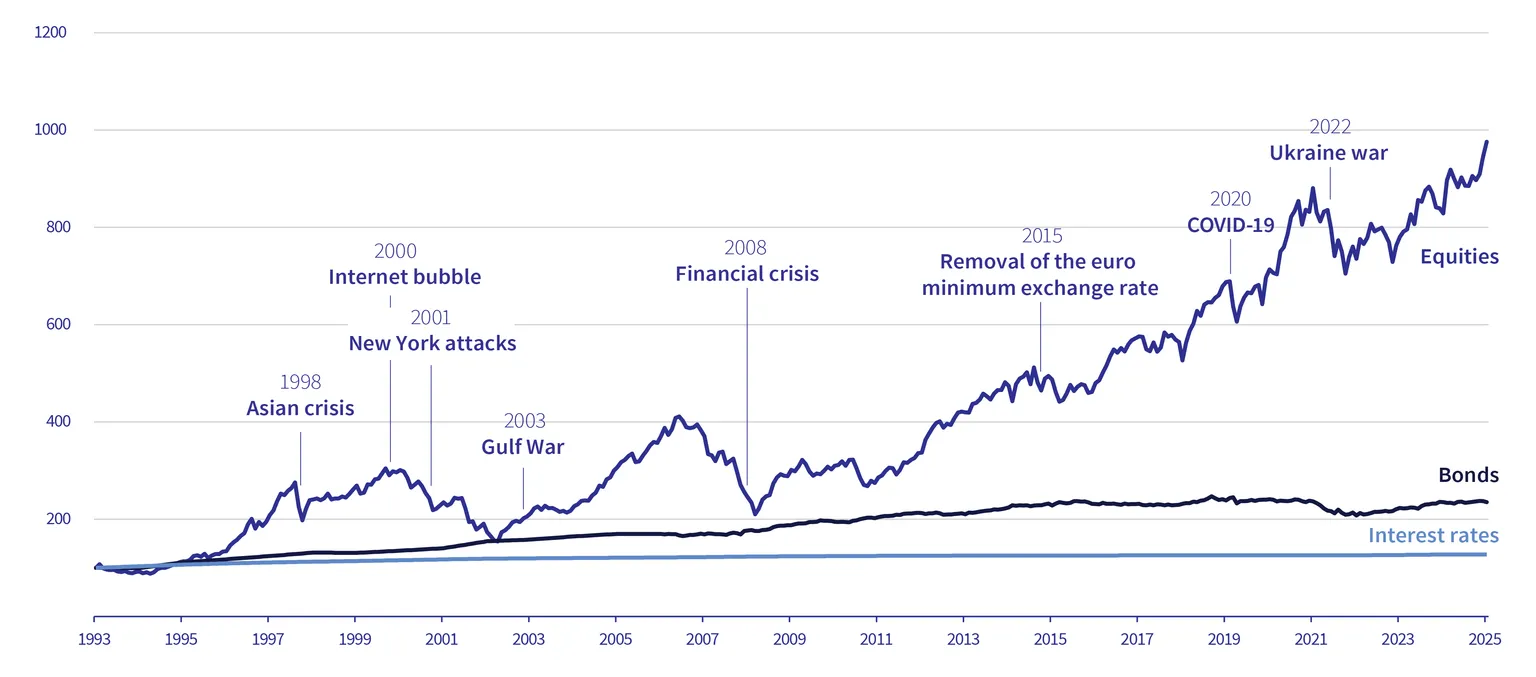
The long-term perspective clearly shows that despite crises, equities have performed significantly better over the long term than bonds and savings accounts.
What does the current market situation mean for my pension?
It is difficult to produce reliable forecasts in the current market environment, but it can be said that price collapses are a feature of the stock market. History also shows that crises have always been overcome, often surprisingly quickly.
Stock market turbulence should be addressed with a cool head. Pension solutions are geared towards the long term, but market turbulence is also a chance to source earnings opportunities, as buying prices are lower (average price effect).
What are the four rules for saving with equities?
Broad diversification
Those who invest smartly spread their capital between different individual equities and regions to avoid cluster risk. Those who invest in AXA’s SmartFlex pension plan, for example, will be cleverly building up their retirement provision and avoiding a pension gap. The investment funds are strongly diversified and investors can choose from four different investment themes.
Long-term investment horizon
All good things are worth waiting for. Surprisingly, this maxim also applies to saving with equities. Keeping calm and thinking for the long-term is usually the best policy. This is because the long-term perspective on market trends of the Swiss Performance Index, for example, over the last 25 years shows that despite crises, equity investments fare much better than savings accounts or bonds in terms of appreciation.
Note the low investment costs
Those who also wish to invest in equities to achieve their savings goals should take a close look at the costs involved. Excessively high costs lead to a substantially lower return. The total cost of an investment consists of the cost of fund management, fund administration and fees for buying and selling fund units. AXA's SmartFlex pension plan which involves investing part of savings capital in equity investments is characterized by comparatively low investment costs.
Regular payments
The general principle for long-term saving is that regular payments and consistent savings discipline are the nuts and bolts for sustainable and continuous capital accumulation. But regular contributions into a return-oriented pension plan also make sense with a view to investing on the stock market. Because those who contribute regularly benefit from being able to buy when prices are low when share prices fall. Here the experts also talk about the average price method in this regard.
Frequently asked questions
What protection mechanisms do insurance companies offer for return-oriented saving on the stock market?
Insurance companies offer various protection instruments for capital accumulation with equities. The SmartFlex pension plan, for example, has an option to pay one part of the monthly savings contributions into safety capital, which earns interest at a fixed rate, and the other part into return-oriented capital, which is invested on the stock market to generate returns. The allocation formula of the monthly contributions can be flexibly adjusted at any time. Additionally, SmartFlex offers more safety options, such as expiration management, manual reallocation or protection of returns. Find out more here on the SmartFlex pension plan.
How safe is retirement provision with equities?
One look at prices and performance over the past 25 years shows that investments in equities have fared considerably better than bonds or savings accounts, despite various crises such as the dotcom bubble around the turn of the new millennium, 9/11 or the 2008 financial crisis. This is the reason why experts agree that broadly diversified equity investments, combined with other instruments, are ideal tools for building up private pension provision.
Do I have to pay taxes on capital gains from my private retirement savings?
No. Private individuals do not have to pay tax on price gains or capital gains in Switzerland. Profits generated from the sale of equities are therefore not subject to income tax. However, the securities in question are subject to wealth tax and must be declared accordingly on your tax return. Income from equity dividends and interest plus similar income is also taxable.
Which companies does AXA invest in?
AXA invests solely in investment funds with broadly diversified equities and pays particular attention to responsible investments.
SmartFlex gives customers the option of making their own investment choices by choosing an investment topic: “Sustainability”, “Switzerland”, “Future trends,” “Global,” or “Dividends.”
Regardless of the investment theme, AXA excludes companies operating in sectors such as tobacco and controversial weapons or that are heavily involved in coal (e.g. >10% coal in their energy mix).
The Swiss three-pillar system
Find out more.
Pillar 1 – state old-age pension/disability pension/earnings compensation
The purpose of Pillar 1 is to secure livelihood in retirement, in the event of disability and incapacity to work, or after a death.
Pillar 2 – occupational pension
Pillar 2 includes occupational pensions, occupational accident insurance, daily sickness benefits insurance, and the vested benefits institutions. It's intended to enable people to maintain the standard of living they're accustomed to after retirement.
Pillar 3 – private pension
By making voluntary payments into a tied (Pillar 3a) or flexible (Pillar 3b) pension, you can close any income gaps from Pillars 1 and 2 of the Swiss pension system to the fullest extent possible.
Always there for you
Do you have any questions, or would you like a pension consultation? We are always there for you!
